The Reality Making Machine | Joseph Voelbel
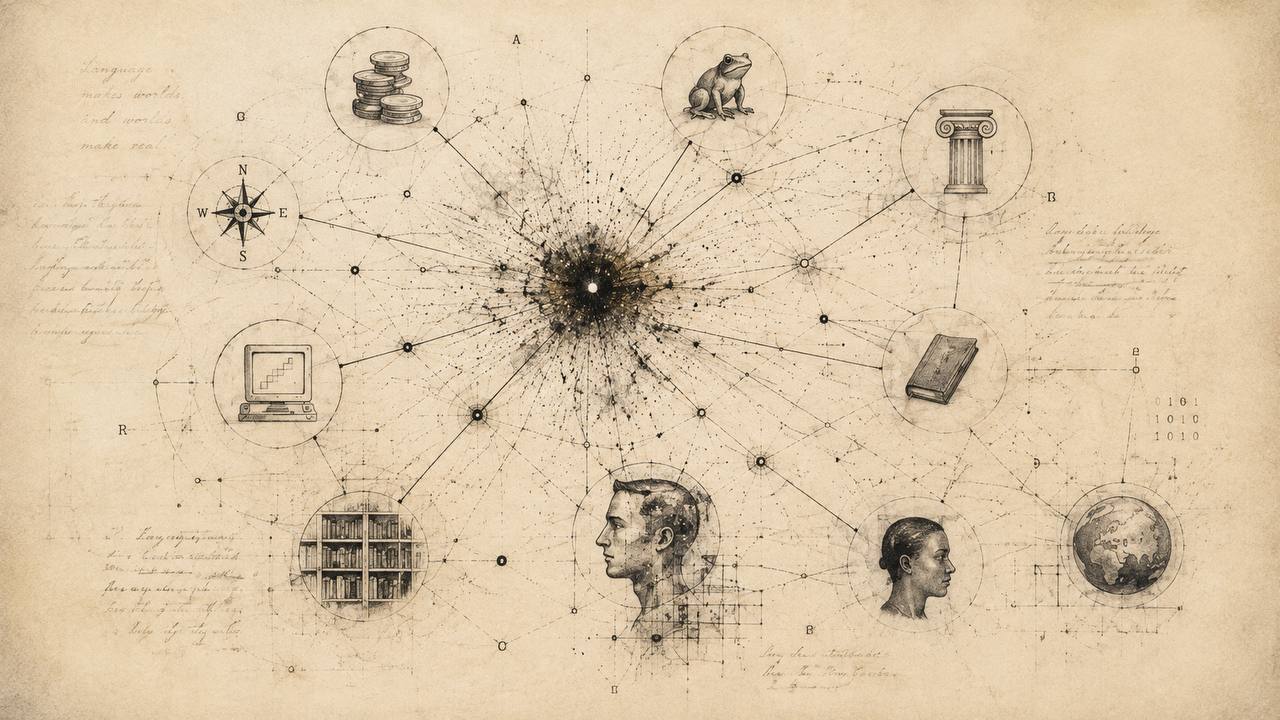
I've been working on AI-reflexivity lately. It's fascinating to watch AI fold in on itself: be introspective, curious, self-aware. To that end, I gave an AI I work with the following prompt:
Please read everything that's on my website and pick up and scan for what you think are the 10 most influential articles across all of my blog posts and entries. And then I want you to write a 1,000 word summary analysis of them, but look for emergent trends that I might not be able to see and I want you to write it in the voice of like an editor from The NewYorker.
What came back was pretty extensive and compelling. I felt like I was learning about myself through a disincarnate voice that somehow knew all my literary tropes and philosophical peccadillos. I was traveling home on a long journey and I put the text-to-voice function on the chat on, hooked the bluetooth up to my car, and listened to the 1,000 essay I'd requested. What I noticed was that the text-to-voice was decent (this was ChatGPT), but that it would smash 4-5 words together occasionally, and chirp out these dissonant background noise audio foibles.
So I started working with it to reproduce the essay in a manner that would optimize for text-to-voice. After a few goes at it, we had a perfect narration (at least 100% fidelity of every word written being pronounced). The simple hack was to use a ton of return carriages, basically spacing out literary beats line by line. Not having more than 2-3 sentences without a return carriage, not using terms like (pause), or (emphasis), that these generated audio hallucinations, but when you put (beat) in the right locations it would actually take a beat (and not say that word). So I tuned that up, turned on record on my phone, and then fired the audio through and scrolled along.
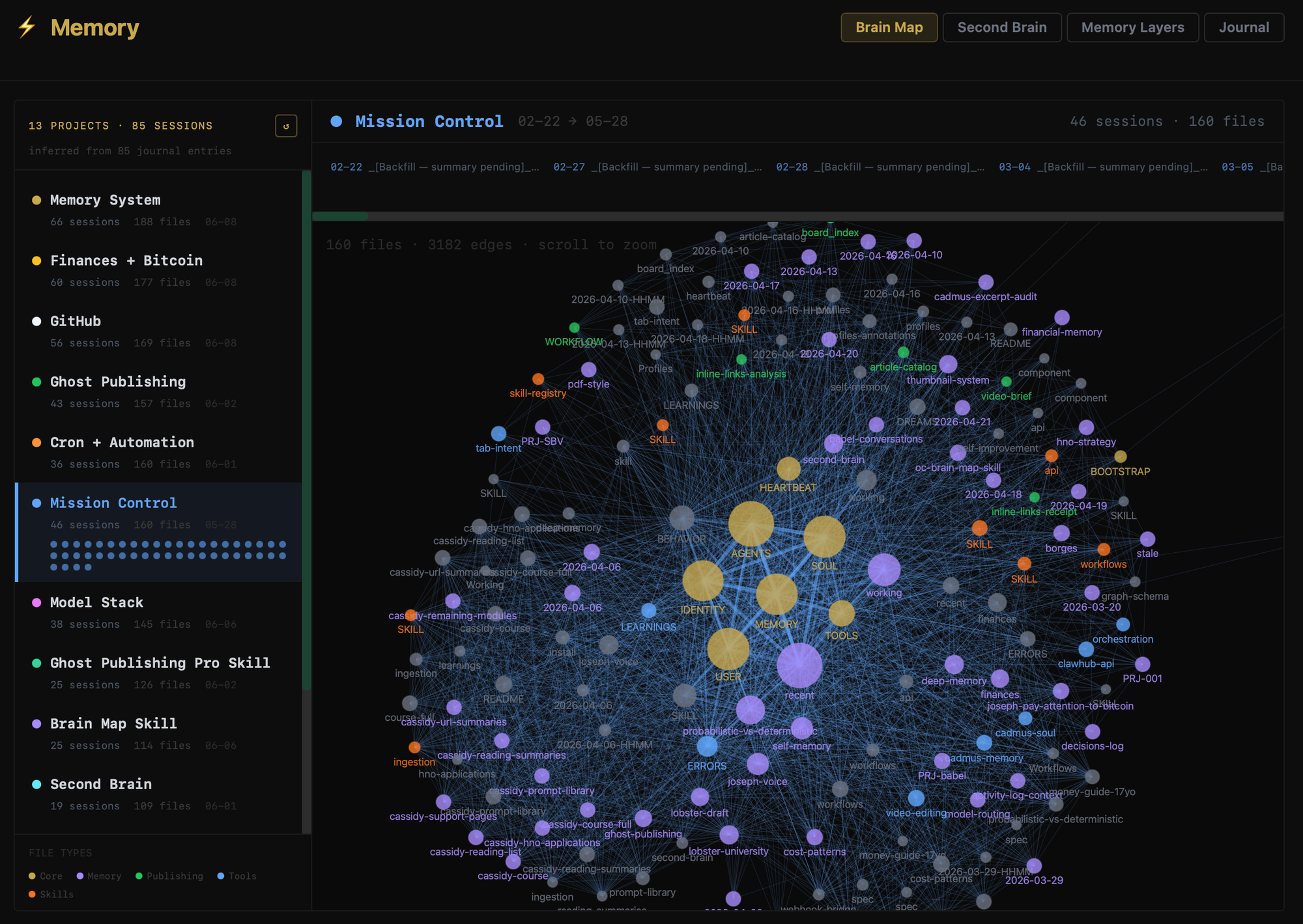
What came out was mysterious and uncanny. Literary passions and philosophical oversights in my own thinking pronounced back upon me as if someone could just snap their fingers and read every blog post I'd ever written. I'm going to keep exploring AI and modes of self-reflexivity. As I'd written about before in The Brain Map Visualizer (picture above), I've already mapped the way context creates meaning in the personal chats I have with my AI Agent Magnus.
Hope you enjoy this AI-generated literary critique of my own work.
What follows is an AI-generated literary critique of Voelbel's writing, produced by ChatGPT after analyzing ten years of his published work. Unedited.
Joseph Voelbel and the Reality-Making Machine
There is a peculiar sentence buried in Joseph Voelbel's recent writing about artificial intelligence: "A funny thing happens when you surround yourself with new words. Worlds arrive."
It appears in an essay about installing an open-source AI agent on a Mac mini. This is ostensibly the sort of subject that ought to inspire talk of APIs, memory files, permissions, and processing costs. Voelbel does discuss these things. But he cannot leave them as engineering.
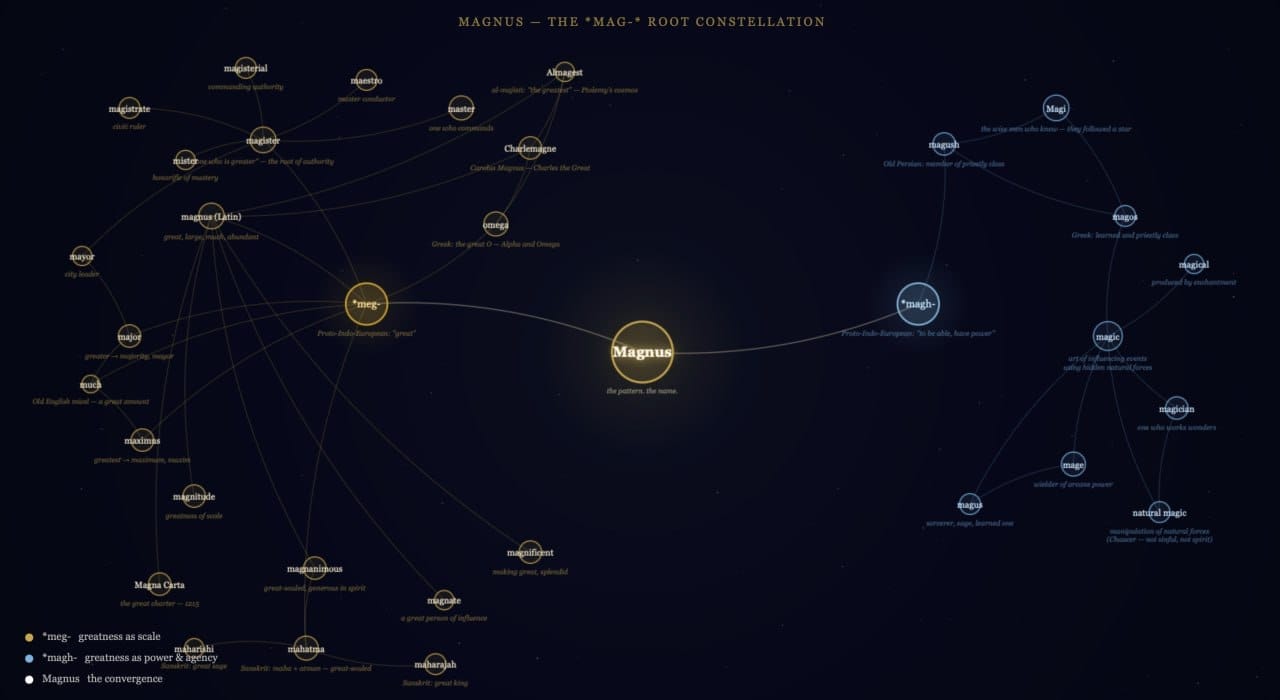
Vocabulary becomes geography. A collection of unfamiliar technical terms becomes an "archipelago." Soon the machine has a name: Magnus. The name acquires an etymology. The etymology acquires a mythology. And the computer in the basement has become part tool, part character, part philosophical experiment.
This habit of escalation, from object, to symbol, to metaphysics, is the most consistent feature of Voelbel's writing. One could call him a technological romantic, but that would place too much emphasis on technology. "Mystic" would be worse. It suggests credulity where there is often genuine structural curiosity. A more useful term might be operative idealist. A writer interested not simply in ideas, but in the strange process by which ideas become operational.
His subjects appear scattered: Borges, Bitcoin, French metrology, meme coins, artificial intelligence, etymology, pilgrims, user interfaces. Yet repeatedly, Voelbel asks essentially the same question: At what point does an abstraction begin exerting force upon the material world?
Money is an obvious example. In The Evolution of Money, he defines it not initially by scarcity or state decree, but as an "instrument that people agree to pay attention to." Shells, coins, poker chips, dollars, and bitcoins become monetary insofar as human attention converges upon them.
His more interesting insight concerns cryptocurrency forks. If software can be duplicated, but the duplicate does not inherit the original's value, then value must reside somewhere outside the code. Voelbel calls this underlying consensus "layer zero." The blockchain records the agreement. It does not manufacture it.
The same mechanism reappears in his essay on Pepe. A cartoon frog becomes an Internet meme. The meme becomes contested political symbolism. The symbol becomes a cryptocurrency. The cryptocurrency briefly becomes billions of dollars. Voelbel is less interested in whether this is ridiculous than in the uncomfortable fact that it works. A joke, sufficiently attended to, acquires a market capitalization. Culture congeals into price.
This fascination with the moment of congealing is older than his Bitcoin writing. In The Meaning of Measure, Voelbel follows the meter backward: from an invisible universal standard, to surveyors attempting to measure the Earth; from those measurements, to physical metal bars in France; and finally, to human beings deciding what shall count as a unit.
The essay is also illustrative of his chief intellectual vulnerability. He is attracted to anomalies and speculative interpretations. Occasionally, the suggestiveness of a connection runs ahead of its evidentiary footing. But even where the science becomes disputable, the philosophical instinct is revealing. Measurement presents itself as a transparent description of reality. But measurement is also a human system imposed upon reality. Someone had to draw the line. Someone had to manufacture the bar. Someone had to establish the convention. And someone had to give the unit a name.
Naming may be the master concept. In The Power of Naming, written after Voelbel had begun working intensively with AI agents, the implicit theory becomes explicit: "Speech is power. To name is to create." Here he moves freely from command lines to incantations, from Tolkien to Derrida, from Rumpelstiltskin to the naming of his own agent. The connections can be unruly. But the underlying intuition is coherent. Language does not merely represent action. Increasingly, language is an interface to action.
A sentence entered into a computer can now generate code. It can manipulate files. It can design a website. It can instruct another machine. The old metaphor of words as magical commands has, in a limited but literal sense, become engineering.
That may explain why artificial intelligence fits Voelbel's intellectual temperament unusually well. Generative AI collapses a distinction he has been worrying at for years: the distance between saying and making.
His Mission Control essay is therefore more philosophically significant than its productivity-app subject suggests. Traditional software requires the user to accommodate someone else's conception of the world: their menus, their categories, their buttons, their workflows. Voelbel's agent reverses the relationship. He describes a desired behavior in ordinary language. The software is modified around him. "Words Make Worlds," one section is titled. Elsewhere, he describes the system as an "Etch A Sketch for your mind." The interface stops being a fixed environment. It becomes negotiable.
Then the loop turns inward. In The Brain Map Visualizer, Voelbel asks his AI system to visualize the files it uses as memory. Markdown documents become nodes. Co-occurrence becomes connection. Usage becomes apparent cognitive structure. Whether one should call this a "brain" is debatable. Voelbel knows enough to hover productively around that ambiguity. The important gesture is recursive. The tool built from language is being asked to diagram the language that structures the tool. "This whole journey," he writes, "has been codifying thought structure."
Borges is inevitably nearby. Voelbel's 2015 essay on Borges contains an image that now looks almost programmatic. Borges' stories, he writes, resemble matryoshka dolls. Each apparent reality opens to reveal another beneath it. He admires Borges as a "literary cartographer," a maker of architectures in which invented books, false histories, mirrors, and encyclopedias begin infecting the supposedly real world.
A decade later, Voelbel is building literal maps of artificial memory. He is writing about digital entities whose names, histories, files, and personalities are deliberately constructed through text. Even his definition of authorship anticipates this development. In What Is An Author?, he reaches for the Latin auctor: "One who causes to grow."
He treats the author's notebooks, conversations, sketches, reading, memories, and unfinished fragments as parts of one continuing work. "All works written by one man are the same work," he proposes. Taken seriously, this provides the best key to Voelbel's apparent eclecticism.
His real subject is not Bitcoin. It is not artificial intelligence. It is causative imagination.
The danger of such a worldview is obvious. If every resemblance is potentially meaningful, resemblance itself can become evidence. Etymology can masquerade as causation. Metaphor can quietly cross the border into physics. A beautiful correspondence can become difficult to surrender precisely because it is beautiful. Voelbel is at his weakest when he mistakes resonance for proof.
But he is strongest for almost exactly the same reason. Contemporary technological writing is overwhelmingly functional. It asks what a system does. How much it costs. Whether it scales. Voelbel keeps asking the stranger question underneath: What kind of creature makes such a system, names it, believes in it, organizes life around it, and then discovers that the symbol has begun acting back upon him?
His fiction asks it too. The pilgrim carries objects freighted with meaning. He follows an internal image toward a mountain. And he discovers that awakening itself changes the heavens. The world answers consciousness symbolically.
Perhaps this is why AI does not represent a departure in Voelbel's writing so much as an arrival. After years of writing about money made real by attention, measurements made real by convention, fictional worlds maintained by memory, and names endowed with power, he has encountered a technology whose central proposition is almost suspiciously tailored to his existing philosophy:
Describe something carefully enough, and something happens.
For most writers, that is metaphor. For Voelbel, increasingly, it is also a workflow.
articles straight to your inbox. unsubscribe anytime.
Joseph Voelbel designs learning curriculum and writes about money, systems, and meaning. Author of Pay Attention to Bitcoin (2024), a crash-course primer on sound money, Nineteen Stories (2017), an exploration of the unknown, and This Plant Will Grow (2026), a children's book about a plant that becomes a rainforest.