The Society for Psychical Research: Past Presidents
In Chapter 1 of The Roots of Coincidence, “The ABC of ESP,” Arthur Koestler prints the list of past presidents of the British Society for Psychical Research. His introduction to it: “they include three Nobel laureates, ten Fellows of the Royal Society, one Prime Minister and a galaxy of professors, mostly physicists and philosophers.” The list runs from 1882 to 1971 and is reproduced here as printed. The narration of the chapter passes over it and points to this page instead.
1882–4 Henry Sidgwick, Knightbridge Professor of Moral Philosophy, Cambridge.
1885–7 Balfour Stewart, F.R.S., Professor of Physics, University of Manchester.
1888–92 Henry Sidgwick q.v.
1893 Arthur Earl of Balfour, K.G., O.M. Philosopher. Prime Minister, Foreign Secretary. President of the British Association, etc.
1894–5 William James, Harvard Professor of Psychology and Philosophy.
1896–7 Sir William Crookes, O.M., F.R.S. Discoverer of thallium, inventor of the radiometer, etc.
1900 Frederic W. H. Myers. Classical scholar. Originated concept of subliminal self, coined terms telepathy, supernormal, veridical.
1901–3 Sir Oliver Lodge, F.R.S. (see above).
1904 Sir William Barrett, F.R.S., Professor of Physics, Dublin. In 1876 read a paper on telepathy in hypnotised subjects to the anthropological section of the British Association, which refused either to appoint a Committee of Investigation or to publish the paper.
1905 Charles Richet, Professor of Medicine. French physiologist, discovered principle of serum therapy. Nobel Prize (1913) for work on anaphylaxis.
1906–7 Rt. Hon. Gerald Balfour (younger brother of Arthur Balfour q.v.). Fellow of Trinity College, Cambridge. Chief Secretary for Ireland 1895–6. President Board of Trade 1900–5.
1908–9 Mrs. Henry Sidgwick (née Eleanor Balfour). First Principal Newnham College, Cambridge 1892–1910.
1910 H. Arthur Smith, M.A., LL.B. Barrister at law.
1911 Andrew Lang. First Gifford lecturer. Authority on mythology and folklore.
1912 Bishop W. Boyd Carpenter, D.D., K.C.V.O., Bishop of Ripon, Canon of Westminster.
1913 Henri Bergson. Philosopher. Professor at the Sorbonne. Academician. Nobel Prize 1927.
1914 F. C. S. Schiller. British pragmatist philosopher, Oxford. Professor, University of Los Angeles.
1915–16 Gilbert Murray, LL.D., Litt.D., O.M. Regius Professor of Greek at Oxford.
1917–18 L. P. Jacks, LL.D., D.D. Editor Hibbert Journal. Professor of Philosophy, Manchester College, Oxford.
1919 Lord Rayleigh, O.M., F.R.S. Nobel Prize 1904. Cambridge Professor of Experimental Physics 1879–84. President of the Royal Society. Discovered argon (with Sir William Ramsey).
1920–1 William McDougall, M.Sc., M.B., F.R.S. Medical psychologist. Professor of Psychology at Harvard, and later at Duke University, N. Carolina.
1922 T. W. Mitchell, M.D. Editor British Journal of Medical Psychology.
1923 Camille Flammarion. French astronomer. Founder and director Juvisy Observatory.
1924–5 J. G. Piddington. Businessman, administrator of the Society's finances.
1926–7 Hans Driesch, Professor of Philosophy, University of Heidelberg. Pioneer of experimental biology.
1928–9 Sir Lawrence Jones Bt., B.A. (Oxon), F.R.S.L.
1930–1 Walter Franklin Prince, Ph.D. American lawyer, student of multiple personality.
1932 Mrs. Henry Sidgwick (President of Honour) q.v. jointly with Sir Oliver Lodge q.v.
1933–4 The Hon. Mrs. Alfred Lyttelton (née Edith Balfour), D.B.E., G.B.E. Delegate to League of Nations Assembly.
1935–6 C. D. Broad, Litt.D., F.B.A. Knightbridge Professor of Moral Philosophy, University of Cambridge. President Aristotelian Society 1927–8.
1937–8 Lord Rayleigh, F.R.S. Physicist. President of the British Association, son of the third Lord Rayleigh q.v.
1939–41 H. H. Price, F.B.A. Wykeham Professor of Logic at Oxford.*
1942–4 R. H. Thouless, Ph.D. Psychologist, University of Cambridge.
1945–6 G. N. M. Tyrrell, B.A. London, Physics and Mathematics. Worked with Marconi on the development of radio.
1947–8 W. H. Salter, LL.B. Classical Scholar.
1949 Gardner Murphy, Professor of Psychology, Harvard.
1950–1 S. G. Soal, M.A., D.Sc. Mathematician.
1952 Gilbert Murray, O.M. q.v.
1953–5 F. J. M. Stratton, D.S.O., F.R.S. President Royal Astronomical Association; Professor of Astrophysics, University of Cambridge; Director Solar Physics Observatory, Cambridge.
1956–8 G. W. Lambert, C.B. Assistant Secretary of State, War Office. Originator of the geophysical theory of poltergeists.
1958–60 C. D. Broad q.v.
1960–1 H. H. Price q.v.
1961–3 E. R. Dodds, F.B.A., M.A., D.Litt. Regius Professor of Greek, University of Oxford.
1963–5 D. J. West, M.D., Ch.B., D.P.M. Psychiatrist and criminologist.
1965–9 Sir Alister Hardy, F.R.S. Linacre Professor of Zoology, Oxford.
1970 W. A. H. Rushton, F.R.S. Director of Medical Studies, Trinity College, Cambridge. Professor of Visual Physiology, Cambridge University.
1971 C. W. K. Mundle, B.A. (Oxon), M.A. Director, Department of Philosophy, University College of North Wales, Bangor.
If one included the Vice-Presidents and officers of the Society’s Council, the list would become even more formidable (e.g. Sir J. J. Thomson, discoverer of the electron).
* Not to be confused with the controversial spiritualist Harry Price.
The Guthrie Drawings
One more thing the narration cannot show. Earlier in the same chapter, Koestler describes the telepathic transmission of drawings in Malcolm Guthrie’s Liverpool experiments: six drawings freely improvised by Guthrie and “transmitted” to the percipient, “Miss E.,” with her reproductions in the row beneath. In the narration, this diagram portion is reached at 0:41:27.
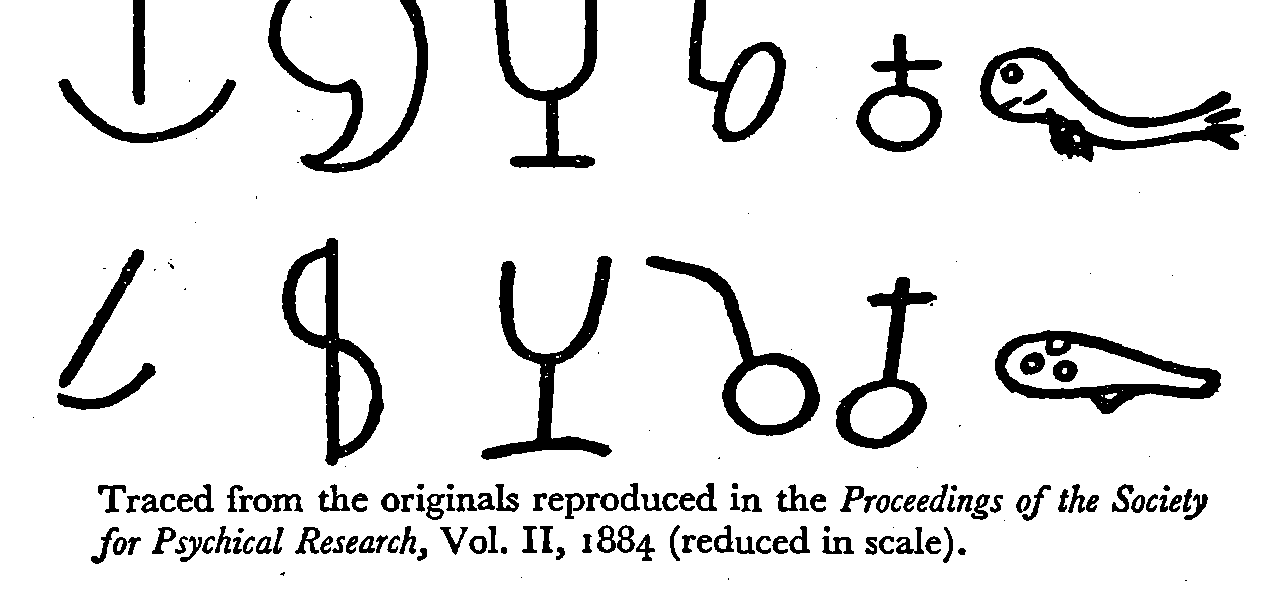
Traced from the originals reproduced in the Proceedings of the Society for Psychical Research, Vol. II, 1884 (reduced in scale).
The Horse-Kick Table
Another table the narration can only describe. Koestler’s classical example of statistical wizardry: the deaths of soldiers kicked by cavalry horses in the German Army from 1875 to 1894, 196 deaths in fourteen army corps over twenty years. From that total alone, a German mathematician calculated the theoretical frequency of zero, one, two or more deaths per army corps per year. In the narration, this table portion is reached at 0:32:12. His summary, read aloud in the narration: theory says two casualties in a single corps in a single year should occur 34.1 times; in fact it occurred thirty-two times. The table is reproduced here as printed, with the figures transcribed below it.
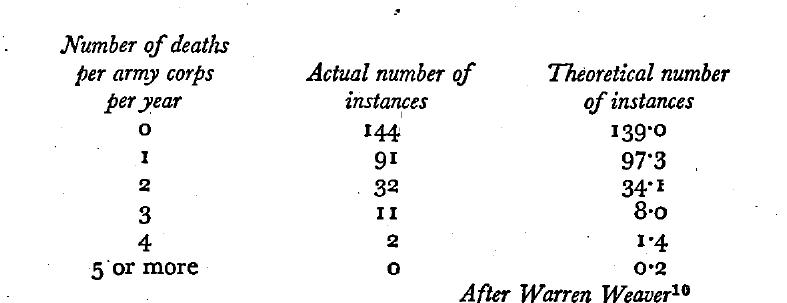
After Warren Weaver.
| Number of deaths per army corps per year | Actual number of instances | Theoretical number of instances |
|---|---|---|
| 0 | 144 | 139.0 |
| 1 | 91 | 97.3 |
| 2 | 32 | 34.1 |
| 3 | 11 | 8.0 |
| 4 | 2 | 1.4 |
| 5 or more | 0 | 0.2 |
* He used the so-called Poisson distribution, derived from the more widely used Gaussian curve.
articles straight to your inbox. unsubscribe anytime.
Joseph Voelbel is the author of Pay Attention to Bitcoin (2024), a thesis on how what we pay attention to accrues value, Nineteen Stories (2017), meditations on the edge of experience, and This Plant Will Grow (2026), a picture book about a plant that becomes a rainforest.