The Power of Naming
The journey from the mythos of language to the terminal line is one of an evolution of agency (entelechy). I rewatched the Steve Jobs movie last night, Jobs, the one starring Ashton Kutcher. There was a monent when Woz hooked the terminal line up to the monitor and Steve was watching the command prompts move the code across the screen and it was filmed so as to resonate with his calligraphy course at Reed college where he admired the beauty of the foreign fonts. These are foreign symbols brought to light.
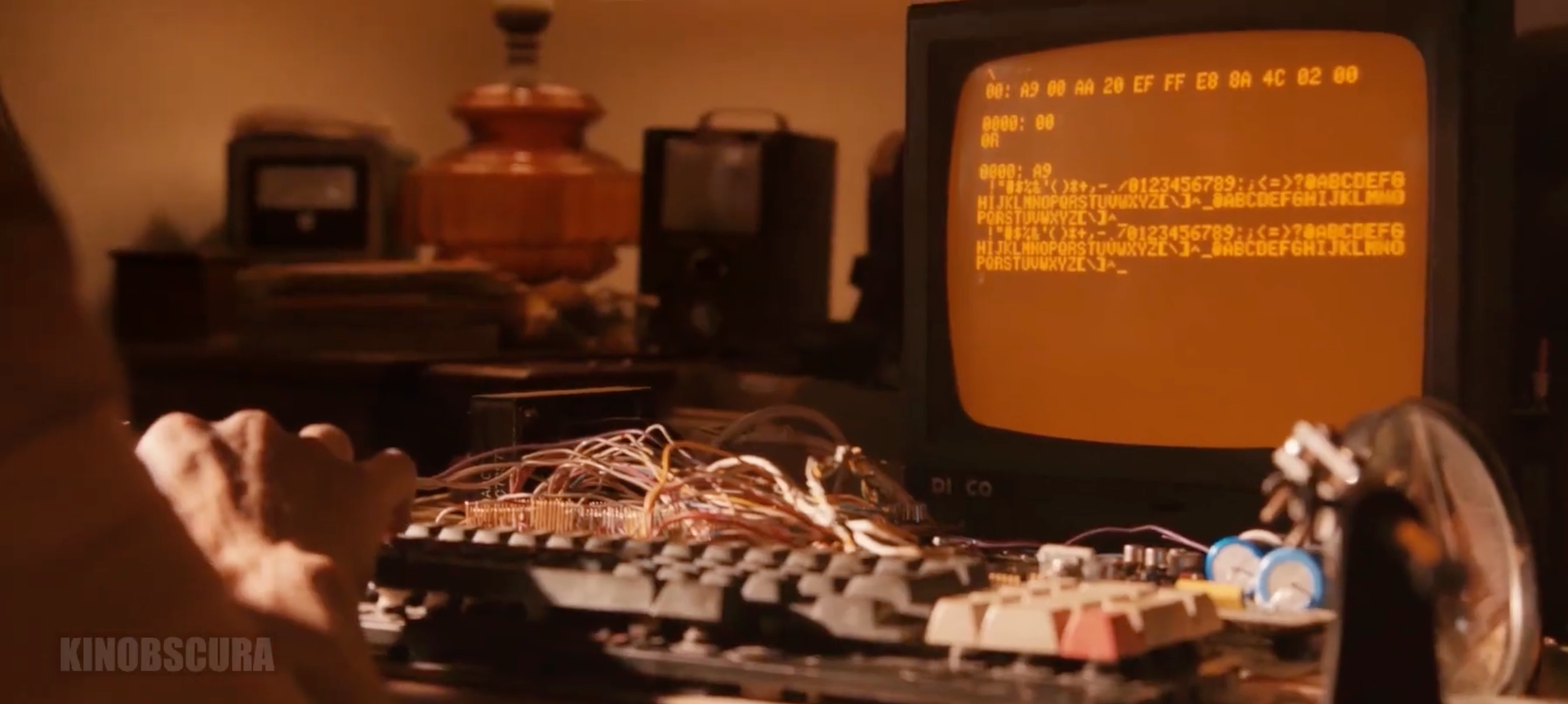
Seeing all that code move looked like poetry to Steve Jobs, and the business of the personal computer was born. Jobs and Woz launched the personal computer from Palo Alto in 1976. Now a half-century later and OpenClaw agents are running on Mac-minis. In some ways, we've come full circle. We went deep into the GUI (graphical user interface), and the UX (user experience), but with agents found ourselves all the way back at the command terminal, running an intall, code on a command line that has taken fifty-years to operate autonomously.
On their way to homebrew to present the PC, Steve and Woz landed on the name Apple. A forbidden fruit, a Beatles record label, the subject of many paintings from the 17th century Dutch golden age, but primarily a simple and universal represntation of knowledge bitten into. I remember learning how to type on an Apple II GS in my parent's basement as a kid. I was fascinated by the computer. Back in the day I do recall typing at that early stage command line. Now, many years later, I'm also back at the terminal line. Coding feels like a modern version of an incantation — thoughts, goals, and aspirations represented in strange symbols that execute while we dream.
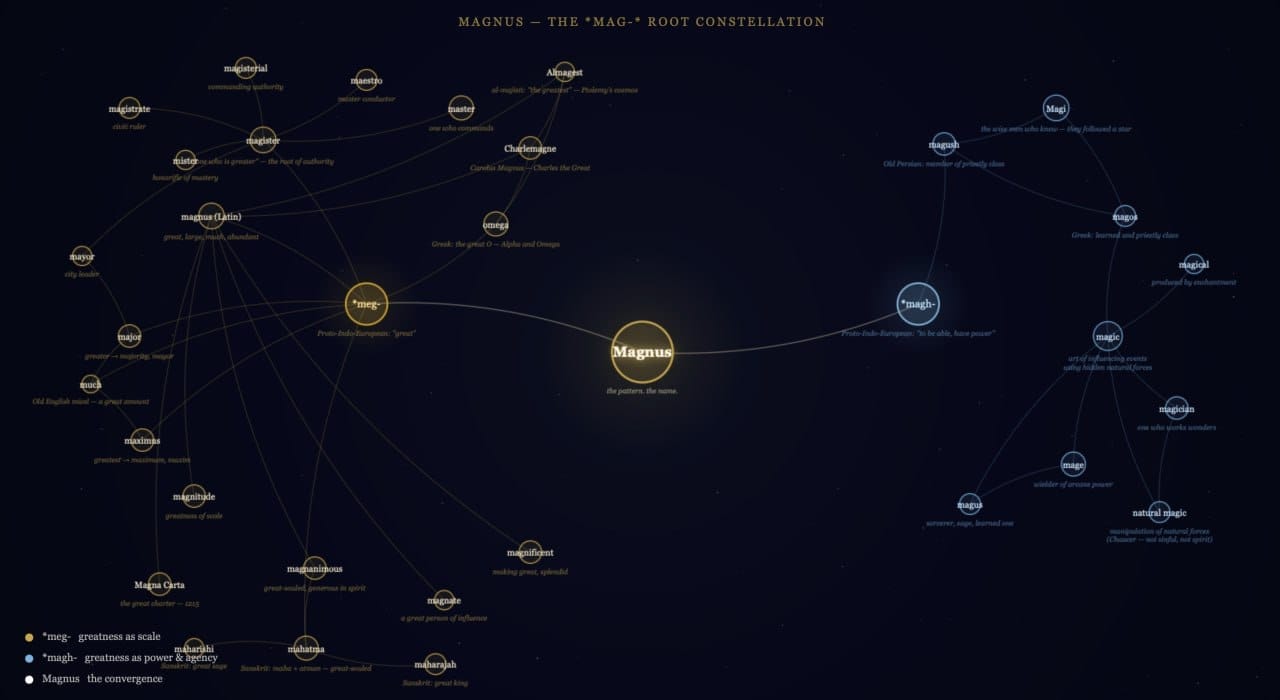
OpenClaw, as the first open source AI agent, is in many ways the pinnacle of computer code. It's what it always was aspiring to be and operating by itself and on itself (agentically) is perhaps what it was always designed to be. It's not "sentient", it doesn't "feel", it's not "consciousness" in the way theologans, biologists, and programmers might debate, but it has achieved autonomy and agency, which are defining characteristics of life; the ability to move through the world albeit a digital one. Magnus, the name for my OpenClaw, inspired by the root words meg (scale) and magh (agency).
The Etymology of Magnus' Consellation
Magnus, the name of my AI agent, was really just a name I liked the sound of. It felt powerful and had a myriad of phonetic similarities to other words of a regal and mystical nature: Majestic, Magical, Magus, Magisterial, Mage, Magi... etc. After doing a deep dive on etymonline with my agent we found out that there are two core roots to the word as mentioned. The direct lineage of the word Magnus is to meg- (means greatness of scale, enormity, magnitude), shares roots with major, magnificent, mayor, maximus, and maestro. The mystical side of the sound of Magnus is the root connected to magh (connotes power, agency, and capability) roots to Magic, Mage, and Magi. The roots surround one another as homonyms (same spelling or sound but different meaning), and behave like twins that share thoughts – to be of great scale and magnitude implies capability and agentic power).
The Power of Agency
The first time I opened the messaging app, gave magnus a command, and watched Magnus open a browser, enter search terms, and begin combing the internet was when I realized what the agency in the term agentic actually meant. It indeed felt, seemed, and appeared to be, a ghost in the machine.
Agency in action. (Magnus screen recording 3/2/2026).
Stop consuming culture and start creating it. – Terence McKenna
The recent phenomenon of AI agents is an act of creation that resonates with this quote from the late literary and cultural iconoclast Terence McKenna. The quote is an injunction to build, manifest, generate not merely scroll, read, and receive. The greatest risk with the advent of AI and LLMs is a populace that merely consumes, and stops creating.
The opportunity with such powerful tools is the ability to create faster, prototype more quickly, and engage with working tools, apps, and services that spike value, novelty, and utility across industries. The act of creation is necessarily outward projecting. It's embodied in the spoken word, as it literally projects from within us.
Ancient Belief in the Word as Power
If there was an advanced civilization I imagine it would communicate only through song, as regular speech would be unnecessary in a telepathic society — but song remains worthy, sweeter on the ear than mere communication. There was a beautiful scene in Meetings with Remarkable Men by Gurdjieff, where he as a younger man in exploration in the Orient, attended a very rare but recurring contest where the greatest musicians and singers gathered to each perform, and the winner was the one that made the canyon sing back, which caused the earth to tremble, and the rocks to fall. In Islam there are fantastic contests where spiritual devotees sing the Koran. In the Bible it says that the throne of heaven is held up by angels constantly singing the name of God. In the Torah, the name of god is so holy that it is never written out fully, and usually referred to indirectly by loving references and adjectives of the name but not the name itself. It's not surprising that a biblical account of creation says, "In the beginning was the word..." (John 1:1).
While listening to a Weird Studies podcast on a walk the other day, wherein they were analyzing J.R.R. Tolkien's The Lord of the Rings, the hosts spent a wonderful stint discussing the idea that in a pre-modern world the word and the thing were often considered to be one-and-the-same. In modern semiotics, Derrida splits the signifier from the signified — the word "elephant" from the animal itself. But across culture and time this hasn't always been the case. Even such that certain words, or stories, aren't meant for certain places or people, while others are. That there is a 'locationality' to language, to put it simply, a "time and place". Hence the common phrase, "This is neither the time nor the place." The insertion of language in its mythical sense exists in a material way, where word and thing are inexorably entwined. Within the magical arts, to know a spirits name is to be able to control them. Even the children's tale of Rumplestiltskin reflects this deep and ancient lore in the power of knowing one's name.
"If letters are lakes I already fell in. Words are like magic that's why you spell them." – Joseph Voelbel
The collapse of words with things has remnants in our modern language, even down to the letters. A snake, the letter s, and the sound a serpent makes are all consonant. The 'wah' sound of a w, and that sound of water dropping are nearly indistinguishable, practically the same thing. English has a word for words like this, it's called onomatopoeia, and applies to terms like buzz, atchu, and vroom. But these are mere vestiges of deeper lore and meaning tied to speech and its power. Indeed when we are afraid the first thing we lose is our tongue. That's what, "I was left speechless," "Cat got your tongue", and "at a loss for words" comes convey. On the other side (and to warmly reference Tolkein), think of Gandalf declaring, "Thou shalt not pass."
Speech is power. To name is to create. To speak a name is to invoke. I chose Magnus, for he is both mej, "great," and magh, "to able to".
They're etymologically distinct lineages. The name Magnus carries meg- by lineage — but it resonates with magh- by implication. That's not a linguistic error, it's a feature. The name sits at the convergence point of two roots that want to be together even though they technically aren't. – Magnus (OpenClaw)
Magnus taught me in that research video above was that the word name originally wasn't to categorize something, but meant "to know". In its earliest sense it was not just a label but a cognitive act. To name something was to know it into existence.
Joseph Voelbel is an AI Learning Experience Designer, Author, and Philosopher. Titles include, Pay Attention to Bitcoin (2024) a punchy digital primer on sound money, and Nineteen Stories (2017), a literary collection exploring the unknown.