Ficciones by Jorge Luis Borges — Complete Narrated Audiobook (English)
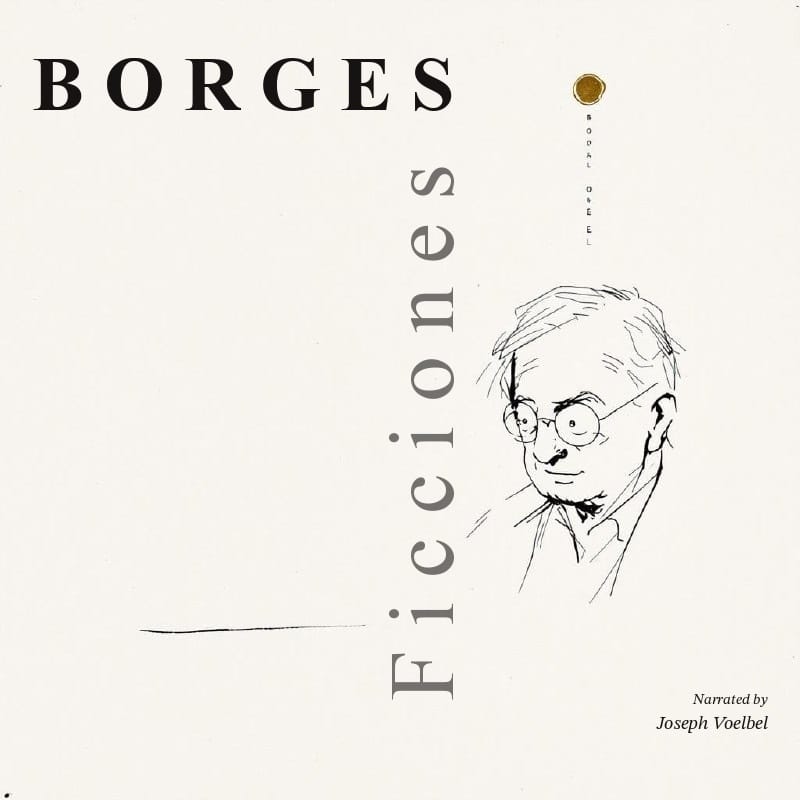
Welcome to the labyrinth.
“A gnostic concatenation of neo-realism meets metaphor, wrapped in a letter, composed between ellipses of a 1,001 nights, a product of Babylon, of the Company, a lost encyclopedia of Tlön reflected in a looking glass, the Schopenhauer in all of us, that every man was Shakespeare, a splash of Kafka, the mathematical precision of a footnote, the journey out of a labyrinth by always going left, an Oxford man who visited a sundial and some oaks, the cult of the Phoenix (or more accurately the secret), the four letter name for God, the obverse side of a twenty centavo coin, a Greek Diana, a learned Librarian in spiraling hexagons, a lone bee casting a stationary shadow, that Garden of Forking Paths which journeyed to the center of the soul, a meeting with Goethe, the metaphysical and everyday implications of memory — Memorious, Imagination, a knife fight because a name was spoken, the ruins of an amphitheater saved by a horse, the journey to see the seer unseen, the space inside a hidden chest at the bottom of a bottomless sea, the educated man, the dream of reality, the belief that Don Quixote was the author of Cervantes, the Odyssey in the form of a book report of James Joyce's Ulysses.
Borges has long been my favorite author. He is a true puzzle maker — the riddler of riddlers, the enigmatist of enigmas.
A story by Borges is not dissimilar to a matryoshka doll. Every time you think you have opened it up and gotten to the bottom of it, there is a smaller, more finite and precise reality beneath that. Initially an essayist and poet, Borges turned to fiction later in life, and it was fiction fused with the realm of fact that would prove to be his trademark signature upon the world.
In 2015, I started narrating Ficciones — his defining short story collection, published in 1944. Seventeen stories. Most translated by Anthony Kerrigan. I recommend doing something away from the screen while listening. It lends itself to preoccupation. Sewing. Sweeping. Doodling. Something automatic enough to let the ideas do their slow work.
In remembering and narrating these stories, I hope, in some small way, to preserve the architecture of one of the greatest literary cartographers to ever grace a pen.
Full playlist on YouTube → — 65,000+ views
1. Tlön, Uqbar, Orbis Tertius
"I owe the discovery of Uqbar to the conjunction of a mirror and an encyclopedia."
— Jorge Luis Borges
What is a world? Borges says: a consistent enough set of ideas, with enough internal logic that the mind accepts it. Tlön starts with a single encyclopedia entry that shouldn't exist and ends with a parallel reality colonizing ours — not through force, but through the quiet gravitational pull of a better story. A mirror at the end of a corridor. A heresy that begins as trivia and ends as architecture. The most dangerous ideas don't look dangerous when they arrive.
Question worth sitting with: If a world is consistent enough to explain everything, do you accept it because it's true, or because you're tired of ambiguity?
2. The Approach to Al-Mu'tasim
"It now seems to me to foreshadow and even to set the pattern for those tales that were somehow awaiting me."
— Jorge Luis Borges
Borges presents this as a book review — a calm, scholarly notice of a novel that doesn't exist. Underneath that, it's a parable: a man moves through increasingly illuminated lives, chasing something he can't name, as if goodness were contagious. Transmissible by proximity. The trick is pure Borges: he gives you a fiction about a fiction, and somehow both feel more real than the room you're sitting in.
Question worth sitting with: When you 'seek the good,' are you really seeking a person, or are you chasing the version of yourself you want to become?
3. Pierre Menard, Author of Don Quixote
"His admirable ambition was to produce a number of pages which coincided — word for word and line for line — with those of Miguel de Cervantes."
— Jorge Luis Borges
Six pages. That's all it takes for Borges to detonate the concept of authorship entirely. Pierre Menard isn't a plagiarist. He's something stranger: a man who tries to write Don Quixote again, word for word, centuries later, so that the 'same' text becomes an entirely different text. The premise reads like a joke. The aftertaste is something closer to vertigo. Where does meaning live — in the words, or in the century they were written?
Question worth sitting with: If the exact same words mean something different in a different century, where does meaning actually live?
4. The Circular Ruins
"He dreamt a complete man — a youth — but this youth could not rise nor did he speak nor could he open his eyes."
— Jorge Luis Borges
A man arrives at a ruined temple with one purpose: to dream a human being into existence. Not as a metaphor. Literally. He is going to build a person inside his mind until that person is real enough to walk out into the world. Borges takes the oldest philosophical question — what makes something real? — and turns it into a horror story. The ending is quiet and brutal and lands like a trapdoor.
Question worth sitting with: If you could be dreamed into existence by another mind, how would you ever prove you weren't?
5. The Lottery in Babylon
"I have known what the Greeks did not: uncertainty."
— Jorge Luis Borges
It starts simply enough. A lottery. Prizes. Then Borges asks: what if the lottery also distributed punishments? What if it governed everything — reputation, fate, the texture of daily life? What if chance and law became indistinguishable? The Company grows until no one can tell whether it's running the world or whether the world was always just running itself, and the Company is the story we told to make it bearable.
Question worth sitting with: If your life can be explained equally well by fate or by randomness, what exactly are you calling 'your choice'?
6. An Examination of the Work of Herbert Quain
"I do not belong to Art, but merely to the history of art."
— Jorge Luis Borges
Borges writes a critical obituary for a dead author who never existed. The fake scholarship is somehow more precise than the real kind. Herbert Quain is a mirror for Borges's central obsession: the idea that literature is a machine for generating labyrinths — false endings, alternate routes, stories that only complete themselves inside the reader. It's short. It bends time anyway.
Question worth sitting with: If a story is designed to make you finish it in your own mind, who is the real author: the writer, or the reader who completes the trap?
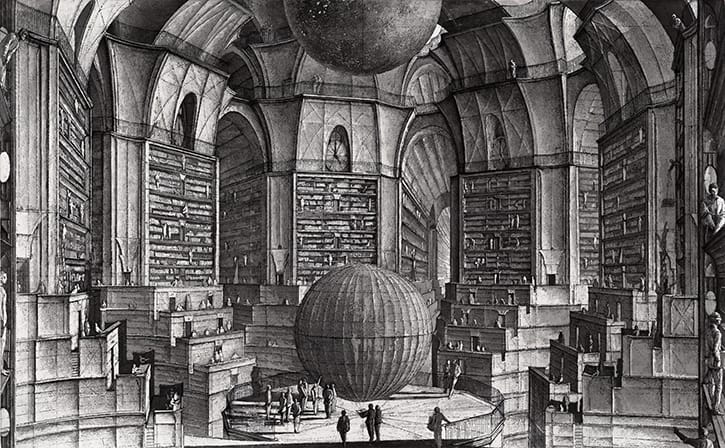
7. The Library of Babel
"The universe (which others call the Library) is composed of an indefinite, perhaps an infinite number of hexagonal galleries."
— Jorge Luis Borges
The Library contains every possible book. Every true statement. Every false one. Your biography. Your refutation. The prophecy of your death. The book that explains everything. The book that explains nothing but looks exactly like the one that explains everything. Once everything exists somewhere, the problem stops being ignorance. It becomes selection. Sanity. Whether the search itself becomes a religion you can't leave.
Question worth sitting with: If you had access to every answer, could you still tell the difference between knowledge and madness?
8. The Garden of Forking Paths
"This web of time — the strands of which approach one another, bifurcate, intersect, or ignore each other through the centuries — embraces every possibility."
— Jorge Luis Borges
Time doesn't move forward. It branches. A spy story becomes a metaphysical blueprint: every choice creates a new timeline, running parallel, contradicting itself, all equally real. The labyrinth isn't a building. It's causality itself. And the 'book' inside the story — the one the old man spent his whole life writing — is actually a map of the universe in the shape of a novel that refuses to end.
Question worth sitting with: If every choice creates a new branch where you chose differently, which version of you deserves credit or blame?
9. Funes, The Memorious
"I alone have more memories than all mankind has probably had since the world has been the world."
— Jorge Luis Borges
After an accident, Funes can remember everything. Every leaf. Every cloud. Every angle of light on every afternoon of his life, in full resolution, forever. You'd think that's a superpower. Borges turns it into a prison. Because perfect memory destroys the capacity for thought. Abstraction requires forgetting. Generalization requires compression. The self you're trying to preserve? It's built on the things you let go.
Question worth sitting with: If forgetting is essential to thinking, what does that imply about the 'self' you're trying so hard to preserve?
10. The Form of the Sword
"Only lost causes can interest a gentleman."
— Jorge Luis Borges
A man with a scar shaped like a perfect crescent moon tells a story about a coward. Borges lets the scar do the work. This one is about betrayal, honor, and the way we hide inside our own narratives — how the structure of a story can shield you from what the story actually says about you. The ending doesn't arrive. It was always there.
Question worth sitting with: When someone tells you a story about 'a man,' how often do you assume they aren't secretly telling you the story of themselves?
11. Theme of the Traitor and the Hero
"That history should have copied history was already sufficiently astonishing; that history should copy literature was inconceivable."
— Jorge Luis Borges
A national hero. A martyr. A murder that becomes myth. A descendant who discovers the 'facts' were staged — not for money, not for power, but because a country needed a story it could organize itself around. Borges at his most chilling: the idea that truth is often less powerful than a narrative. That history is written by whoever understood storytelling better than reality.
Question worth sitting with: If a lie creates a nation and a truth would destroy it, what do you owe the truth?
12. Death and the Compass
"Lonnrot thought of himself as a pure thinker — but there was something of the adventurer in him, and even of the gamester."
— Jorge Luis Borges
The detective's fatal flaw is intelligence. He sees patterns. He finds them. And in a Borges universe, a mind that loves symmetry will walk willingly into a trap shaped like meaning. Kabbalah, geometry, interpretation, and murder moving together like gears. The deeper Lönnrot goes, the more the case stops being 'who did it?' and becomes 'what does it mean?' — which is exactly where Borges likes to kill you.
Question worth sitting with: When you find a pattern, how do you know you discovered it, rather than stepped into the one someone wanted you to see?
13. The Secret Miracle
"The time for your work has been granted."
— Jorge Luis Borges
A man is going to be executed at dawn. He has one unfinished play burning inside him. He prays for time — not to escape, not to argue his case, just time to finish the thing he was built to make. Borges grants the miracle in the only place it can happen without breaking physics: inside consciousness. The world stops. The body is already dead. But the mind gets a year.
Question worth sitting with: If you finished your life's work perfectly but no one ever saw it, would it still count as completed?
14. Three Versions of Judas
"To Runeberg they were the key with which to decipher a central mystery of theology."
— Jorge Luis Borges
Borges writes theology like detective fiction — as an investigation where every conclusion is a trapdoor. A scholar decides to 'solve' the betrayal at the center of Christianity. He follows the logic all the way down. The solution gets progressively more monstrous with every revision. Erudition as suspense. Blasphemy as pure logic. This one stays with you.
Question worth sitting with: When does interpretation stop being insight and become a way of making evil feel necessary?
15. The End
"He looked down without pity at his great useless body."
— Jorge Luis Borges
A crippled man in a general store watches time pass. A stranger arrives. A debt comes due. Borges writes this ending the way some people write prayers — brief, unsentimental, final. When it ends, it ends the way the Argentine plain ends: no explanation, no comfort, no uplift. Just consequence. It's the shortest story in the collection and one of the most complete things I've ever read.
Question worth sitting with: If you knew the 'end' of your story was waiting for you somewhere specific, would you avoid it, or walk toward it to be done with uncertainty?
16. The Sect of the Phoenix
"Only one thing — the Secret — unites them and will unite them until the end of time."
— Jorge Luis Borges
Borges describes a secret society with no scripture, no creed, no banner you can point at. It exists in every culture, every century, among all kinds of people. Held together by one thing: a secret so ordinary and so universal that it becomes cosmic once you frame it right. Borges in full anthropological mode, making the familiar feel like a revelation.
Question worth sitting with: If a ritual is universal but never spoken aloud, is it 'meaning,' or just the shape of being human?
17. The South
"'The South' can be read as a direct narrative of novelistic events, and also in another way."
— Jorge Luis Borges
Most Borges stories feel like puzzles. The South feels like fate. A man recovers from a near-fatal accident and travels toward the Argentine plain — toward the mythic South that has always lived in his imagination as lineage, as romance, as the version of himself he never got to be. Borges plants a blade of ambiguity in the ribs of the narrative and never pulls it out. The question isn't whether Dahlmann survives. The question is which story he's already inside.
Question worth sitting with: If your mind could choose the story you die inside, would you pick truth or a beautiful ending?


articles straight to your inbox. unsubscribe anytime.
Joseph Voelbel is an AI Learning Experience Designer, Author, and Philosopher. Titles include Pay Attention to Bitcoin (2024) a punchy digital primer on sound money, and Nineteen Stories (2017), a literary collection exploring the unknown.